
Average global growth prospects for the next 12 months and the next three years are 35 per cent and 49 per cent, respectively.

The Nifty finished the day at 10,265.65, a hefty gain of 98.95 points, or 0.97 per cent, after shuttling between 10,270.85 and 10,195.25.
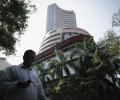
Risk sentiment received a boost after eight core sectors grew to a five-month high of 4.9 per cent in August

Technically speaking, US equities have seen net losses since January. India is strongly influenced by US trends.

The annual list, released on Wednesday by Geneva-based World Economic Forum, comes at a time when the new Indian government has completed 100 days in power and has promised further steps to revive its economy and the ease of doing business in the country.

A yellow glow is likely to stand out amid grey geopolitical clouds in 2023, with gold price projected to touch Rs 60,000 per 10 grams in the Indian market as more investors veer towards safe-haven assets. In a year where volatility was more a norm than an exception, gold prices in the international market oscillated from a peak of $2,070 per ounce in March to a low of $1,616 per ounce in November and is steadily recovering since then, according to market experts. At the beginning of 2022, gold prices were around $1,800 an ounce.

'It is time to allow the rupee to move towards its true value, as it is hurting Indian exports, investment and SMEs associated with export sectors that create jobs,' argues Pravakar Sahoo.

Globally, jewellery buying fell 14%, investment slid 11%.

IndusInd Bank was the top gainer in the Sensex pack, soaring over 7 per cent, followed by Bharti Airtel, HCL Tech, Tata Steel, Tech Mahindra and Dr Reddy's.
.jpg)
Silver also recorded a significant rise of Rs 950 to Rs 38,750 per kg.

Bajaj Finserv was the top gainer in the Sensex pack, soaring around 8 per cent, followed by Tata Steel, Tech Mahindra, Bajaj Finance, HDFC Bank and SBI.

Kotak Bank was the top gainer in the Sensex pack, rising over 3 per cent, followed by IndusInd Bank, Bajaj Finance, HDFC Bank, ICICI Bank, Bajaj Finserv, Maruti and SBI.

The NSE Nifty too recovered over 100 points, or 0.96 per cent, to end at 10,576.85.

Silver also remained under selling pressure.

Gains were led by index heavyweights Reliance Industries and Infosys.

UltraTech Cement was the top gainer in the Sensex pack, surging over 3 per cent, followed by L&T, Dr Reddy's, Bajaj Finserv, Sun Pharma, TCS and Kotak Bank. NSE Nifty gained 68.30 points to finish at a record 16,705.20.

'Macro headwinds are rising for Indian equities in the form of rising commodity prices, especially oil, depreciating rupee, fiscal challenges, election-related uncertainty and upside risks to inflation'

Investor sentiment got a boost following remarks from the Russian President Putin that allayed fears of an imminent military conflict in Ukraine
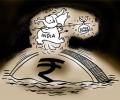
FIIs have offloaded stocks worth Rs 13,110 crore

Among the many exits from the billionaire's club in 2022 are D Uday Kumar Reddy of Tanla Solutions (net worth down 66 per cent), Sushil Kanubhai Shah of Metropolis Healthcare (down 65.7 per cent), Vijay Shekhar Sharma of One97 Communications (down 66 per cent), and C K Birla (down 43.4 per cent).

Theoretically, there is an inverse relationship, but other factors need to fall in place for it to work well this time
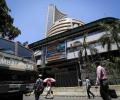
The 50-share NSE Nifty stayed in the green for the most of the session and hit a high of 10,397.70, before closing at 10,379.35

The partnership will look to expand Ford's reach in the fast-growing Indian market and improve M&M's access to global markets

As per the findings, CEOs are less optimistic about prospects this year.

BHEL down around 2.4% and Bharti Airtel down around 1.6% were other major losers.

The trend was visible in the early trade on Thursday as investors indulged in trimming their bets after the minutes of the US Federal Reserve's September meeting indicated a possible rate hike this year.

India's exports are unlikely to get an immediate boost from a depreciating rupee, which touched an all-time low on Monday, driven by rising commodity prices. The rupee fell to 76.97 against the dollar earlier in the day, settling 1.05 per cent weaker than the previous close. Oil prices soared to their highest since 2008 on Monday at $139 per barrel, after the US and European allies explored a Russian oil import ban, while delays in the potential return of Iranian crude oil to global markets increased supply fears.

Tata Steel was the top gainer in the Sensex pack, climbing 2.11 per cent, followed by Infosys, HDFC Bank, HDFC, Kotak Bank, M&M and PowerGrid. NSE Nifty jumped 142.05 points to end at 17,605.85.
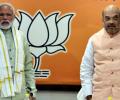
Corporate leaders said a stable government at the Centre will help boost infrastructure spend, address agricultural distress, and encouraging employment.

The BSE Sensex spurted 130.00 points to end at 35,980.93, while the broader NSE Nifty advanced 30.35 points to 10,802.15.

Benchmark indices failed to sustain gains and retreated from day's high dragged primarily by the losses in metals, information technology and bank shares as investors started to book profits in late noon deals. Earlier, markets had scaled fresh all-time highs on the surprise post-budget rate cut by Reserve Bank of India (RBI). The 30-share Sensex ended down 213 points at 29,380 and the 50-share Nifty closed down 74 points at 8,922. Intra-day, Sensex reached the all-time high mark of 30,024.74 while Nifty touched the life-time high level of 9,119.20. In the broader market, both the BSE Midcap index and Smallcap indices, down 1% and 1.2% each underperformed the front-liners. Market breadth in BSE ended negative with 1,882 declines against 1,010 advances. A day after signing an agreement with Finance Ministry on inflation targeting, RBI surprised the markets with an early post-budget repo rate cut of 25 bps (basis points) to 7.5% from 7.75% which was again outside of central bank's scheduled policy review meetings as the earlier rate cut effected on January 15. "RBI's latest rate cut of 25 basis points, while a surprise in its timing is in-line with our expectations of a sharp rate-cutting cycle over the coming quarters. With inflation sustainably lower by 500bps, the RBI has in recent months acknowledged the scope for rate cuts and was only waiting for additional comfort that the government's fiscal policy would not play spoil-sport," said Dinesh Thakkar, chairman and managing director at Angel Broking in a note. Analysts at Karvy believe that further monetary policy action will depend on number of factors including easing of supply constraints, improved availability of power, land, minerals and infrastructure, fiscal consolidation, the pass through of rate cuts by banks and the expected monsoon. Citing weakness in some sectors of the economy and the overall global trend towards monetary easing as rationale for the rate cut the central bank also exuded confidence in the road map for fiscal consolidation as laid out in the Union Budget, 2015. Commenting on how the markets reacted to RBI's surprise move, K Subramanyam assistant vice-president (institutional research), Asit C. Mehta Securities said, "The unexpected cut did take the market by surprise .However, credit off-take is not dependant only on interest rates. A gradual revival in the economy would be of more help which would trigger credit off-take. Hopefully this will follow and RBI's action would prove helpful. From market point of view this is bullish as equity becomes more attractive vis-a-vis falling interest rates." On the macro-economic front, the HSBC services PMI rose to an eight-month high of 53.9 in February up from 52.4 in January indicating strong expansion in output across the sector. Respondents cited robust growth of new business as the principle factor for the increase in activity. Meanwhile, foreign portfolio investors (FPIs) bought shares worth a net Rs 773 crore on Tuesday, as per provisional data. Buzzing Stocks 9 out of the 12 sectoral indices of BSE ended in red. BSE Metal index, down 2.4% was the top loser followed by BSE Oil & Gas and Power indices, down 1.3% each. BSE Healthcare index, up 1.2% and BSE FMCG index, up 0.9% were the top losers. Bank stocks came under during late noon trades as traders booked profits at higher levels. However, RBI rate cut may encourage large lenders to cut their lending rates boosting demand for home and auto loans and provide funds for various stalled and new projects. Many stalled projects across the country are waiting for cash to restart work. The stock of stalled projects at the end of December 2014 stood at Rs 8.8 lakh crore or 7% of GDP. ICICI Bank ended down 0.1%, Axis Bank and SBI declined over 3% and HDFC Bank shed 1.5%. Sun Pharma gained over 6% on approval granted to Sun Pharma Advanced Research Company (SPARC) by US FDA for an antiepileptic drug. The product will be manufactured by Sun Pharmaceutical Industries at its Halol (Gujarat) facility in India. SPARC was formed in 2007 when Sun Pharma separated out its active projects in drug discovery and innovation into a new company. Dr Reddys Lab and Cipla have gained over 1% each. ITC gained over 1% after consecutive sessions of losses on the proposed larger-than-expected hike in excise duty on cigarettes in the Union Budget. The biggest ever auction of spectrum by the Department of Telecommunications (DoT) started on Wednesday in the morning where government expects to garner Rs 80,000-1lakh crore from the sale of spectrum. Idea Cellular gained over 2%, Reliance Communication gained around 1% and Bharti Airtel closed 0.5% higher. Metal stocks were under pressure in today's session. Hindalco declined over 3%, Sesa Sterliteended down over 4% and Tata Steel closed down 2%. Profit-taking in IT stocks led to Wipro losing around 1.8%, Infosys declining 0.7% and TCS losing 1.5%.

Volkswagen overtook Toyota as the world's largest carmaker by sales.

Global consultancy firm PwC India on Wednesday said it will invest up to Rs 1,600 crore and create additional 10,000 jobs in the next five years. Announcing its new business strategy 'The New Equation', PwC India said the firm will also increase its campus hiring by over five times in the same time period. The New Equation is based on analysis of trends and thousands of conversations with clients and stakeholders, it said in a release.

The global COVID-19 situation, rollout of vaccines, geopolitical trends, Union Budget and economic recovery would be the major factors driving investor sentiments in 2021 after a tumultuous year which saw both 'the worst of times and the best of times' for the stock market, said analysts. What a year 2020 turned out to be! From witnessing gigantic losses to record-shattering gains, investors went on a roller-coaster ride amid the coronavirus pandemic and massive stimulus measures. Markets closed 2020 with remarkable gains of around 16 per cent, but will the winning ways continue in 2021 as well?

Gold surged to a fresh all-time high of Rs 28,540 per 10 grams in the bullion market today on sustained buying by stockists and investment-driven purchases fuelled by the bullish trend in international markets.
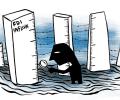
Foreign Direct Investment into India rose by 13 per cent in 2020, boosted by interest in the digital sector, and while fund flows "declined most strongly" in major economies such as the UK, the US and Russia due to the Covid-19 pandemic, India and China "bucked the trend", the UN has said.

Mid- and small-cap indices have outperformed the frontline benchmarks - the S&P BSE Sensex (up around 10 per cent) and the Nifty50 (13 per cent) - in the first half of calendar year 2021 (H1-CY21) by rallying 26 per cent and 39 per cent, respectively. The trend, analysts believe, is likely to continue in H2-CY21 as well. The outperformance in H1-CY21 comes on the back of improved earnings and strong inflows from the foreign portfolio investors (FPIs) in Indian equities. However, good monsoon so far, gradual opening up of the economy and the pick-up in the pace of vaccination provides support to the market.

India will have 1 billion smartphone users by 2026 with rural areas driving the sale of internet-enabled phones, a Deloitte study said on Tuesday. India had 1.2 billion mobile subscribers in 2021, of which about 750 million are smartphone users. It is poised to be the second-largest smartphone manufacturer in the next five years. "The smartphone market is expected to reach 1 billion smartphone users by 2026," according to Deloitte's 2022 Global TMT (Technology, Media and Entertainment, Telecom) predictions.

Strong gains in metal, energy, auto and power shares lifted the key indices to new highs.

This will be an area where bilateral or regional trade pacts may not be able to perform well.
